

The financial landscape of 2026 is unrecognizable compared to just a few years ago. While the “suits and ties” of Wall Street once dismissed blockchain as a fringe experiment, the narrative has flipped. Today, with trillions in assets moving on-chain and regulatory frameworks like the CLARITY Act providing the green light, investors face a $36 billion question:
Are tokenized stocks actually better than traditional ones?
Whether you’re a “buy and hold” veteran or a DeFi native explorer, understanding this shift isn’t just about following a trend, it’s about maximizing your capital’s efficiency. In this guide, we’ll break down the rivalry between legacy equity and the tokenized revolution, and why platforms like Edel Finance are becoming the new standard for the modern portfolio.
1. What Are Tokenized Stocks?
At its core, a tokenized stock is a digital representation of a traditional company share, issued and managed on a blockchain. Think of it as a “digital twin” of a stock.
When you buy a tokenized share of Apple (AAPL) on a platform like Edel, you aren’t just buying a number on a screen; you’re holding a token that is typically backed 1:1 by the actual underlying share held in a regulated vault.
How It Works (The “Magic” Behind the Scenes)
The process involves “wrapping” a traditional security into a smart contract. This contract governs everything from dividend distributions to ownership transfers without needing a room full of lawyers and brokers to sign off on every move.
Real World Example: In the traditional world, if you wanted to buy $10 of Apple stock but a single share costs $220, you’d need a broker that specifically supports fractional shares. In the tokenized world, fractionalization is native. You can buy $1, $0.50, or even $0.01 of any stock because the blockchain treats the asset like digital currency infinitely divisible and instantly transferable.
2. What Are Traditional Stocks?
Traditional stocks represent the “Gold Standard” of the 20th century. When you buy a share through a legacy broker (like Schwab or Fidelity), you are the “beneficial owner,” but the actual record keeping is a complex between varies parties:
- The Broker: Your entry point.
- The Exchange: Where the trade happens (NYSE, NASDAQ).
- The Clearinghouse: The middleman that ensures the buyer has the cash and the seller has the stock.
- The Transfer Agent: The final record keeper for the company.
The Limitations of the Legacy System
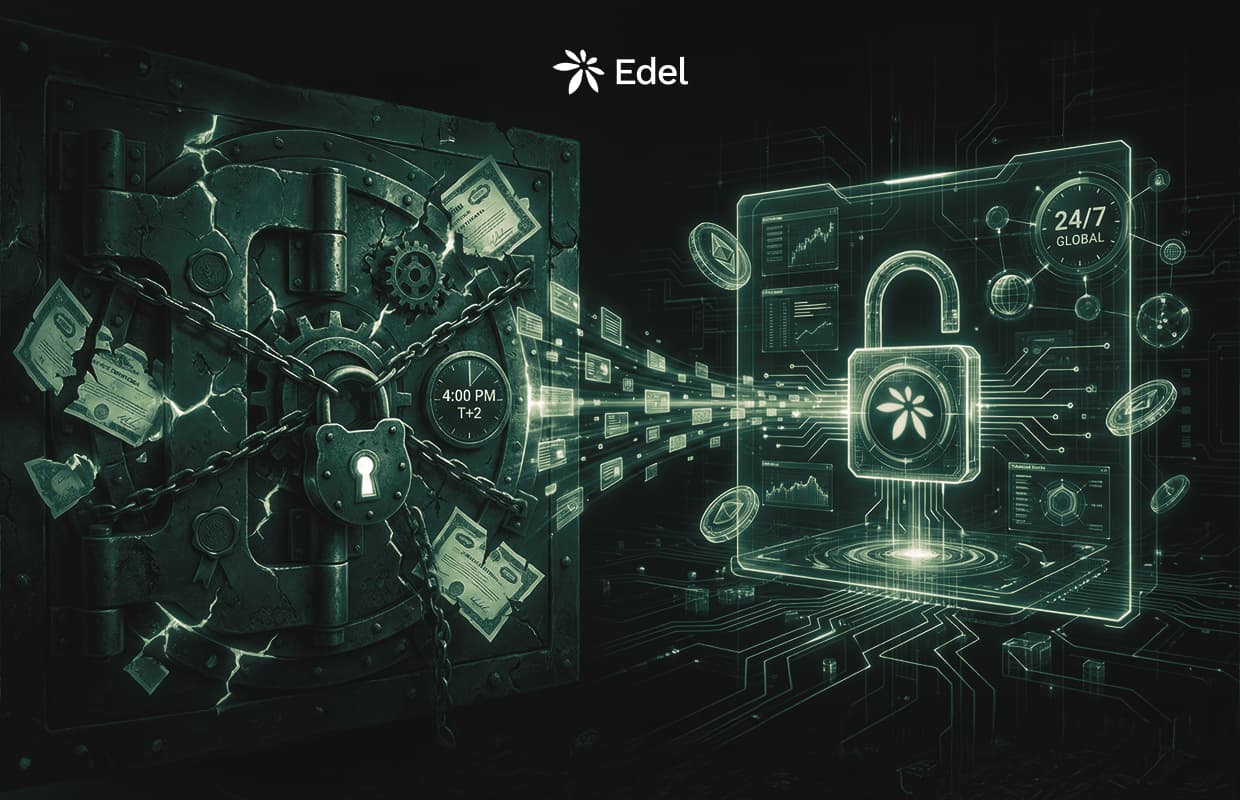
While stable, this system is a dinosaur. Most trades still operate on a T+1 or T+2 settlement cycle (meaning it takes 24–48 hours for the money to actually be yours). Furthermore, the markets “sleep.” If news breaks at 6:00 PM on a Friday, you’re stuck watching your portfolio value shift in the shadows until Monday morning.
3. 6 Key Advantages of Tokenized Stocks
1. True 24/7 Global Access
The world doesn’t stop at 4:00 PM EST. If a tech giant announces a breakthrough at 3:00 AM on a Sunday, tokenized investors can trade on that news instantly. For international investors, this removes the “time zone tax” of staying up all night to catch the New York opening bell.
2. Fractional Ownership Without Restrictions
Traditional brokers have spent years trying to “bolt on” fractional shares. On platforms like Edel, it’s baked into the code. You can build a diversified “Mega Cap” portfolio with just $50, owning slices of 20 different companies.
3. Instant Settlement vs. T+2
In 2026, waiting two days for your money to clear feels like using a dial-up modem. Tokenization enables Atomic Settlement: the stock and the cash swap hands simultaneously. You can sell a stock and immediately use those funds to buy another asset or pay for dinner using a linked card.
4. Lower Barriers to Entry
No more complex “international account” applications or minimum $10,000 balances for premium access. Tokenization democratizes Wall Street, allowing a student in Bangkok and a fund manager in London to access the same Tesla shares on the same terms.
5. Enhanced Transparency & Auditability
Every transaction is etched into the blockchain. You don’t have to trust that your broker actually bought the shares; you can verify the smart contract and the custodian’s holdings in real time. This eliminates the “opaque” nature of traditional dark pools.
6. Programmable Features (Smart Contracts)
Imagine a stock that automatically reinvests dividends into a different asset based on your preset rules, or a portfolio that rebalances itself without you lifting a finger. That is the power of Programmable Finance.
4. Limitations & Risk Factors
Every market evolution comes with its own set of friction points. To navigate this space effectively, investors must account for the following complexities and risk factors currently facing tokenized assets:
- Regulatory Evolution: While the 2025/2026 legal push has helped, rules still vary by country. A tokenized stock in the EU (under MiCA) might have different rights than one in the US.
- Platform Risk: Not all platforms are created equal. You must ensure your provider uses fully regulated custodians to hold the underlying assets.
- Voting Rights: Some tokenized assets are “synthetic” or derivatives, meaning they track the price but don’t give you a vote at the annual shareholder meeting. Always check if the token grants beneficial ownership.
5. When to Choose Which?
Choose Traditional Stocks if:
- You are a high-net worth individual requiring specific SIPC insurance protections.
- You require formal proxy voting rights for corporate governance.
- You prefer the “old school” tax reporting integration of a local broker.
Choose Tokenized Stocks if:
- You want to trade on your own schedule (nights/weekends).
- You are starting with a smaller capital base ($100).
- You want your assets to be “liquid” and usable.
- You live outside the US and want direct access to the NASDAQ/NYSE.
The 2030 Outlook: Convergence
By the end of this decade, the distinction between “traditional” and “tokenized” will likely vanish. BlackRock CEO Larry Fink famously predicted that “the next generation for markets is the tokenization of securities.”
By 2030, the “digital twin” will likely be the only way we trade. Tokenization isn’t just a new way to trade it is the modernization of ownership itself. Offering more transparency, more access, and more control to the individual investor.
